Alarming increase in coronavirus cases.
For several weeks now, the WHO Regional Office for Africa has been warning that the continent would experience its third wave of coronavirus if countries did not rapidly strengthen public health measures.
In the week of 7-13 June, the African region recorded a 36.3% increase in new cases. Twenty-four countries experienced an increase in the number of weekly cases with some countries such as Mozambique, Rwanda and Senegal experiencing an increase of 20% or more. The countries most affected by this third wave remain Uganda, Namibia and South Africa. In terms of lethality, the figures are also regrettably increasing. For example, Mali and Burkina Faso have shown a high case fatality rate in recent weeks.
This increase in cases in the region can be explained by several factors. Firstly, the presence of more contagious variants on the continent such as the South African variant or the Alpha and Beta variants can be attributed to this increase in cases. Secondly, the lack of adherence to preventive public health measures and the onset of winter in the southern African region may also be contributing to the rise in cases.
This pandemic has already led to widespread disruptions in essential health services in most countries in the region. This worrying increase in coronavirus cases is therefore of concern as it would suggest that health systems already burdened by the pandemic will be overwhelmed by the arrival of coronavirus patients in the coming weeks.
However, the recent example of India and the Western countries a few months ago has clearly shown that even the most robust health systems can be quickly overwhelmed by many coronavirus patients. For this reason, Dr Moeti, WHO Director for the African Region, called on countries that “have already vaccinated their high-risk groups, to significantly expand and bring forward their pledges to share doses."
Shortage of vaccine in the African region
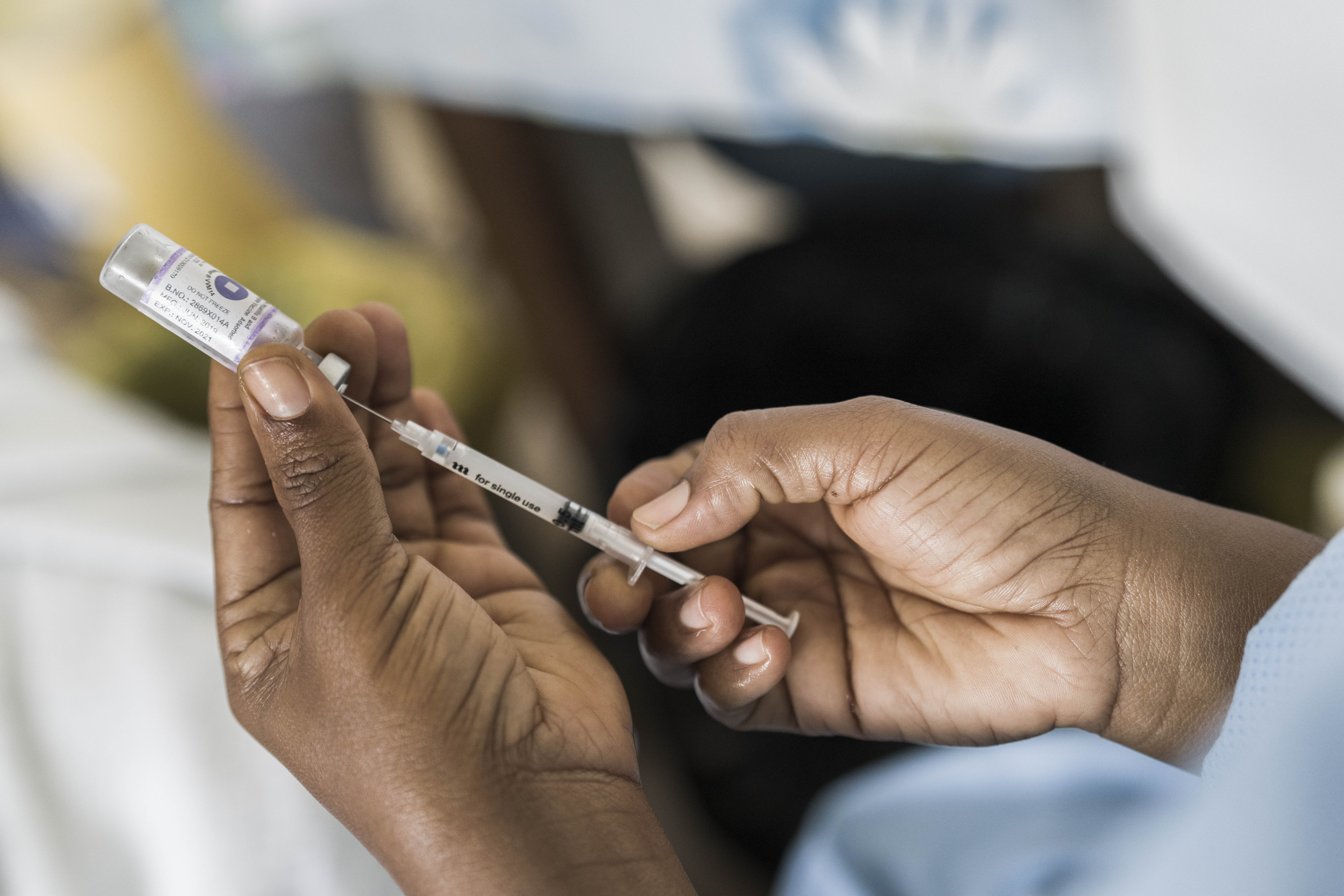
To date, 51 African countries have been able to vaccinate their populations either through doses received by COVAX, donations or bilateral agreements. However, while Africa is experiencing its third wave of coronavirus, this represents less than one percent of the 2.2 billion doses administered globally. This vaccine inequity translates into "28.5 doses per 100 people globally, and 65 doses per 100 people in high-income countries compared with 2.5 doses per 100 people in Africa and 1.5 doses per 100 people in sub-Saharan Africa".
In this regard, Dr Moeti, Director of the WHO Regional Office for Africa, rightly recalled that:
"while many countries outside Africa have now vaccinated their high-priority groups and are able to even consider vaccinating their children, African countries are unable to even follow up with second doses for high-risk groups."
Although 35.2 million doses have been administered in Africa, at this rate African countries may not reach the World Health Assembly target of 20% of the African population being immunised, equalling 600 million doses, by September 2021, unless 225 million doses are distributed across the continent. For this reason, WHO/AFRO has repeatedly called on countries that have vaccinated a large portion of their population to send doses to those who need them most, namely medical personnel and vulnerable people. Indeed, the number of infections among health workers is worrying as it continues to rise in countries such as South Africa, Kenya and Ghana.
However, vaccines are struggling to reach the continent, especially for the 40% of countries in the African region that rely on COVAX or the Serum Institute of India, as these doses are predominantly and primarily administered in India.
In addition, although 8 countries in the region have been able to administer all the doses received to their population, some countries have reported not being able to administer the doses received. This is mainly due to logistical challenges, lack of adequate infrastructure, qualified personnel and/or funds but also hesitation of their population.
The upcoming weeks remain crucial for the African fate and once again it is important to remember that "no one is safe until everyone is safe".
Actions taken to combat vaccine inequity
In order to combat this vaccine inequity, an initiative to create a technology transfer hub in South Africa was announced on 22 June 2021 by Dr Tedros Adhanom Ghebreyesus, WHO Director General, South African President Cyril Ramaphosa and French President Emmanuel Macron.
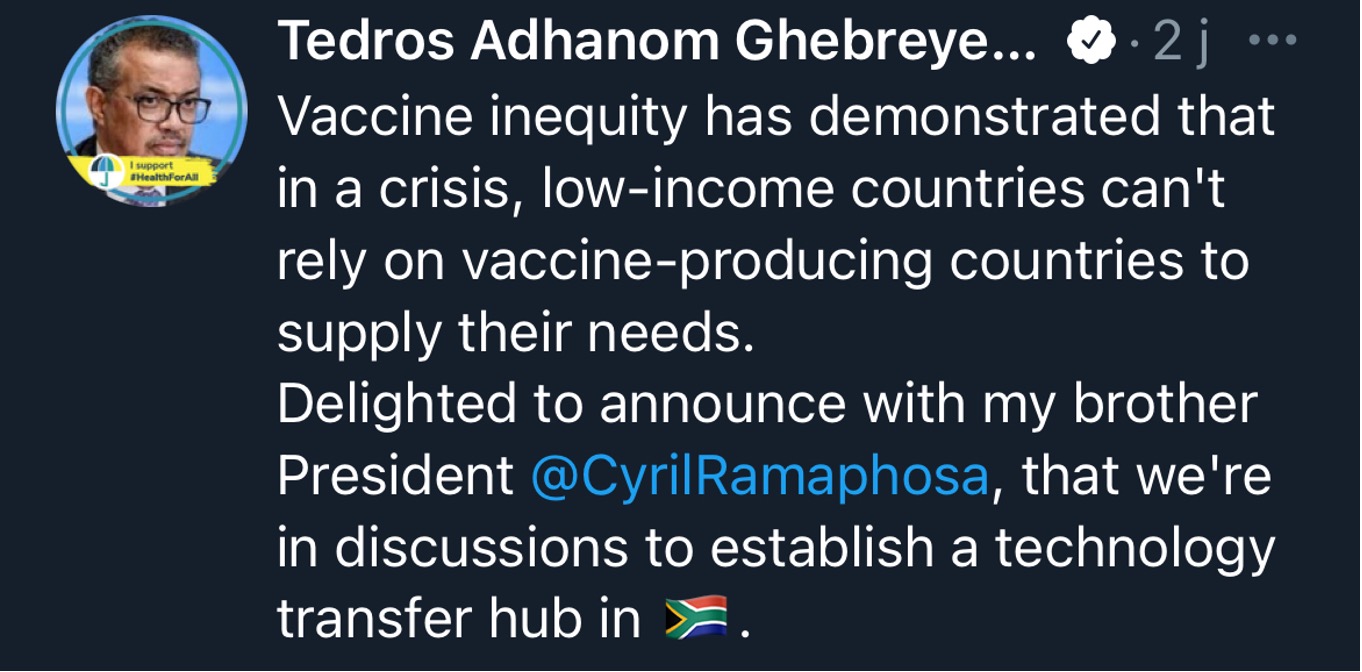
In the Opening statement of the COVID-19 Press Conference of the WHO AFRO, Dr Moeti, WHO Director for the African Region also welcomed the news, saying that the technology transfer centre “will contribute to closing the gap in access to vaccines and it is a strong example of quickly translating political will on local production into action.”
The creation of this consortium follows the WHO's call on 16 April 2021 for public and private companies to express interest in establishing technology transfer centres to enable low- and middle-income countries to have their own technology transfer centre for the COVID-19 mRNA vaccine.
Supported by WHO, this South African consortium to establish the first COVID mRNA vaccine technology transfer centre will increase production and access to COVID vaccines on the African continent. This will enable manufacturers in African countries to receive solid training in vaccine production as well as to obtain the necessary licenses for vaccine production.
The role of WHO and its partners will be to provide production know-how, quality control and intellectual property rights to accelerate the dissemination of the technology. The manufacturer Biovac will be the developer, the biotech company Afrigen and the network of universities will provide the knowledge of messenger RNA, with technical support from Africa CDC. In the long term, this consortium will also allow the development of new vaccines, as President Macron pointed out in a video posted on Twitter.
However, as the WHO Director General mentioned: "This is an important step that will produce results in the medium term. In the short term, we must do everything in our power to increase the production and equitable distribution of vaccines through Covax. "
In this respect, the United States recently promised to donate 80 million doses of vaccine to foreign countries, including three quarters of the doses destined to COVAX. While the donation is welcome, Dr Bruce Aylward, WHO's COVAX focal point, said that COVAX has a shortfall of about 200 million doses.
In order to fill this gap, other institutions such as the World Bank and the African Union have announced a partnership that would support the Africa Vaccine Acquisition Task Team (AVATT), an initiative of the African Union Commission, Africa CDC, Afreximbank, the AU Special Envoys for COVID-19, and UNECA. The partnership commits to providing resources to enable African countries to purchase and deploy vaccines reaching up to 400 million people.
Critical role of communication at country level
However, the fact that vaccines are available does not necessarily imply a population willing to be vaccinated. Several events have contributed to the reluctance of the population to be vaccinated. A report commissioned by the Africa CDC on COVID-19 perception in 15 African countries found that the willingness to accept COVID-19 vaccine was highly variable across African countries, with higher acceptance reported in Ethiopia and Niger to lower willingness reported in Senegal and DRC.
This vaccine hesitancy can be caused by safety issues. In fact, several African countries have had to suspend vaccination campaigns at some point because of fears about the side effects on young adults of vaccines such as AstraZeneca, as it has been reported in Europe and the United States. As a result, several young adults working in the health sector had refused to be given these doses. Similarly, Interpol announced that it had dismantled a fake vaccine network in South Africa, thus not reassuring the South African population.
Countries therefore play a key role in reassuring their populations regarding this hesitancy, but also in the fight against misinformation and fake news circulating on social networks.
Indeed, on social networks several posts are circulating saying that Covid-19 is abroad and not in Africa or saying that Africans are laboratory rats for Covid-19 vaccines. In this regard, the above-mentioned Africa CDC report shows that 66% of those surveyed “report having seen or heard at least some rumors about COVID-19, with 42% claiming to have been exposed to a lot of disinformation”.
In order to counter these misinformation and disinformation, associations and governments have set up platforms where it is possible to report these false news as well as to verify the information circulating on the net (e.g. Real111 website in South Africa).
Some African countries also opt for the judicial solution in order to discourage Internet users who spread fake news, as is the case in Senegal and Zimbabwe for example.
To set an example, several leaders of African countries were quickly vaccinated, live on television, as was the case with the President of Ghana Nana Akufo-Addo or the President of the Seychelles Wavel Ramkalawan, in this manner proving to their populations that vaccines are not only reliable but also necessary to curb this disease.